Wednesday, January 27, 2010

Your Blog Face

I have often found students feeling stymied by the task of choosing a title for their essays. I’ve been there too. I often just get done writing this THING, this organic fusion of thoughts and experiences and facts and outside opinions, and now I have to name it? And not just any name, but something that both gives a fairly clear sense of the actual content of the essay and yet offers a hint of creativity or language play. It’s no wonder academics “cheat” by introducing a colon to the mix; thus, as McDonald’s two-sided Styrofoam McDLT containers kept “the hot side hot and the cool side cool,” the two-sided academic essay title can keep the creative side separate from the quasi-literal side.


Which is taking longer to decompose? The styrofoam containers or the McDLTs?

Similar to the agony of choosing a title (an agony bloggers are not free from), there can be much hand-wringing when choosing an appropriate image to represent your blog. Much like an essay title, this image “labels” the blog. It offers a specific visual to the reader that to some degree influences the tenor of the site. Most popular blogs simply have a logo that incorporates their blog title that serves this function as the blog’s image. We in the 109.02 class are not ready to create custom logos for our oh-so-many followers yet, as I assume that no one in the class is strong enough at HTML to introduce a comprehensive design change, replete with logo. What we can do is let a graphic do the representation for us.


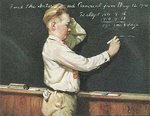
My particular choice of clipart shows a young man, “The Genuine Drafter,” fretting in front of a chalkboard, who appears to be contemplating what he wrote and what he will be writing. I am quite happy with this image, as it captures in the face of the young man what I call “the sweet agony” of the writing act. I have considered changing the image because it looks as if the young man might be currently engaged in a math problem; however, at the picture’s size, all that can be made out for certain is that there is writing on the board, and, truly, the expression of the writer is what I most want my blog image to, ahem, express.


A rejected image. Consternation, yes. Sweet agony? Nuh uh.

Wednesday, January 20, 2010

Coming this Fall on MTV: Real World Freshman Comp Class

This past autumn, I was fortunate to take part of an English course at The Ohio State University designed to offer experience and guidance in writing articles for professional journals. For the course, designed and taught by Dr. Cindy Selfe, we students were prompted to select a previously written (in some form) essay that we see as being a strong candidate for publication. We selected our work and the target journal and set about revising for the audience we now hand in mind. Additionally, we assumed the mantle of reviewers for the pieces that our clasmates wrote. The entire course was not only an opportunity to better understand the process of producing and re-producing (AND . . . re-producing) an article for a professional journal, it also gave "real-world" application (that is to say an actual audience and purpose) for the writing we were doing in the course.


This real-world application for freshman composition is often harder to achieve for many reasons. As graduate students with backgrounds in Rhetoric and Composition, we in Dr. Selfe's course shared a common discourse community that--despite our specializations and journal selections--kept genre from being an issue in peer review. Likewise, our experience with writing cannot be discounted. Finally, despite what we may believe, I would hazard a guess that most school administrators and department heads (even publicly vocal former heads) would argue that the writing in our classrooms should be designed to be applicable primarily for the writing done in other classrooms (and secondarily to keep T. Rex from symbolically destroying the fabric of the universe). That is to say, composition is first and foremost an instruction in academic literacy. And, in many senses, this class is no different.

However, by turning our attention to blogs while simultaneously writing many conventional schoolroom compositions, we in 109.02 may are trying to better acquaint ourselves with both the academic essay as genre and the blog as genre. A better understanding of both makes for a better understanding of either. At least, that's the hope.Like other classes that try to make such writing tasks more palatable, freedom of topic choice is key. Such is so for the blogs we write, and it is so for the outsider blogs we are expected to read and comment on each week.

Despite this freedom, I am fully aware that most students would not participate in reading blogs weekly (no matter the topic) and contributing comments unless a grade depended upon it. And depend upon it it does, so we will be participating in something quite artificial, even as we venture into the "real world" and comment upon the blogs of others. So the best I can hope for is that at some point during any given comment, the spirit of the conversation inhabits the writer, the 109.02 blogger, and she or he finds herself or himself posting comments of interest, out of the need to communicate, expressand further the conversation--even if the spirit grips for merely half a sentence.

Of course, I may be seller the 109.02 bloggers short. They've had some fun reads thus far.

Monday, January 11, 2010

It begins . . .

As we embark upon the coming semester of weekly blog posts, let us remember, 109.02 class and followers, that the writing and reading we will be doing online is indeed real writing and reading. It is not "less than" the writing that you will be expected to deliver in the form of essays, nor is it necessarily easier to convey messages and emotion. We will investigate how form and function is similar to most classroom writing and how it differs.

Ultimately, if I can be allowed a moment of cheerleading, I hope that these blogs serve to be sites of agency for you--places where you feel that you can express, analyze, synthesize, champion, and reject ideas without too much restriction (of course, with a concurrent awareness of an audience nonetheless). If much of the communication in our lives take the form of static or noise, let these blogs be distinct, proud voices that carry over the rabble. And let's have fun with them too.

Friday, March 6, 2009

The Guest Blogging Experiment, 2009


In last year's 109.02 course, the bloggers undertook a covert mission to guest post on a classmate's blog about that particular blog's subject. After everyone read the guest posts and commented on them, the original bloggers wrote follow-ups about the experience of having someone else post on what had been up to that point mainly their text (of course, the inclusion of comments always complicates the ideas of authority and authorship).

Upon reflection, the "invasion" into their hypertextual space gave the bloggers many things to think about.

  • There were discussions of how the guest bloggers opened new avenues for content on the blogs: "What this means to me, to have this post on my blog is that I have a new perspective on how to shape this blog. When I picked this topic, flipping cars for a profit, I thought I had to write only about how I flip cars and what to do right and what to do. From having this post on my blog, I can talk about the cars them self. Not just about my experiences in flipping cars."
  • There were realizations that the text can alter the style of the author: "I found in Chase Hardwick’s post the guest writer was more of a joking funny guy compared to Doc Hardwick’s more informal type of posts. He did well by staying with the theme of Doc Hardwick and found a study that showed that in “moderation” (this is a different meaning to everyone) alcohol is beneficial to ones health. But the picture was the main tip off that gave away the fact that it wasn’t Doc speaking in the post."
  • And in some cases, the little differences in style stood out to the original authors: i also have noticed a lack of enthusiasm considering a Halo topic is my most favorite topic to write. the writer uses the i have played halo before enthusiasm as opposed to my Halo Geek jargon. Also being that i am a huge Halo fan I would have put a video link from the website G4TV from the episode were they talk about the game Halo Wars. I also noticed that the picture was placed in the middle of the blog and i like to place my pictures in the left hand corner of the post.
So what will this round of bloggers notice about the differences of style, the notion of authority, the constraints of topic or genre? We shall see. Do you want to surf through their musings on the subject? Be my guest.*

*Horrible, horrible pun.

Friday, February 20, 2009

Back it up!

Oh, the multi-purpose phrasal verb. You take on so many interpretations.

As the students of the 109.02 class dive headlong into the first draft of their second papers--for which they are to read a blog/online article summarize it, and respond to it--I thought it was a good opportunity to discus the merits of the reverse outline.

Written after a draft of a paper is complete, a reverse outline is an attempt to describe the text that has been written, whereas a traditional outline, usually sketched before drafting, is typically an attempt to impose (prescribe) a structure and focus for the paper. When writing a reverse outline, an author writes down a few words that describe the topic of the paragraph. When the author discovers more or fewer than one paragraph topic, he may need to reconsider that paragraph. This also provides a wonderful opportunity to check a paper's organization between paragraphs (a popular understanding of the nebulous "paper flow").

Traditional outlines are written and assigned with the intent of helping the author collect his or her thoughts and organize them. Reverse outlines--well, they are written and assigned for just the same reason. Neither outline is essentially superior to the other; typically, their applicability to a writing task is dependent upon the author. Do you need to organize your thoughts before writing? Be traditional. Do you need to get your ideas out first before ordering them? A reverse outline is for you. Most experienced writers find time for conducting both outlines, even if just on scratch paper (like me), in the paper's margins (like me), or in their heads (like . . . well, you get it by now).

Remember the things to look out for when writing a reverse outline:

  1. Paragraphs that have more or less than one central topic.
  2. Paragraphs that do not work in transition to one another or in their place in the paper as a whole.
  3. Paragraphs that are not meeting the expectations of the assignments (for example, in this assignment, the readers would expect to see a summary of the original blog early on in the paper)
Long live the reverse outline! And while we're revering backward things, let's hear it for the moonwalk, Kriss Kross's clothes, and Cooper's Dream from Twin Peaks!

Perhaps next week we'll look at another meaning of "backing up," that of supporting our writing with examples, statistics, anecdotes, and the like.

Friday, February 13, 2009

Setting an Example, Yadda, Yadda, Yadda

The students in 109.02 are embroiled in the business of discovering meaty blog posts to summarize and respond to for their second essays. I thought, in the spirit of lifting the veil of what can be a challenging assignment, I would briefly model the sort of thing they will be pending the back half of the quarter working on. This may be my bet chance at a modeling gig, save for, perhaps, hand modeling a la George Costanza.

But really, who could compete with silky mitts such as these?

In "Student Blogging--What You Should Know," Sean Rahman of Michigan State University offers a series of tips for the nascent classroom blogger. Rahman notes that some college students will be asked by their teachers blog as part of their coursework, a pedagogical decision that Rahman sees as having many positive effects. Classroom blogs, he surmises, can offer opportunities for lateral learning, create additional means of communication between students and teachers, and "generally make writing more exciting for students." Stressing that classroom blogging is different from blogging in more informal contexts, Rahman lists a series of practical tips for the student blogger. Some of Rahman's suggestions range from urging the student to be aware of the opportunities and constraints of the technology (creating back-up files of all posts and allowing for computer mishaps are covered, for example), some deal with identity (blogging anonymously) and some with community (commenting on classmates' blogs).

Rahman's post trends toward the practical, and some of it could and does apply to using computers for any sort of composition; actually, if the students haven't been persuaded to budget for technical issue in their composing processes now, I doubt that this essay will inspire them to do so. The essay is hinting at being stronger when asking the reader to consider the importance of community in blogging, but Rahman again stays at a practical level, warning the student of half-hearted comments on others' blogs: comments such as "Try to put some "meat" into your post as well--many instructors won't give full credit for 'Me, too!' comments that don't contain any content" are important for students to read, but they shed no light for the student on just why thoughtful comments are integral to the communication found in blogs.

And perhaps this is my hang-up, that in fact the more theoretical sort of explanation is better left to another article. However, I really do think that Rahman misses an opportunity for real edification, having raised the specter of the importance of comments. Why settle for what amounts to a fleshed out checklist in an article that purports to offer students what they "should know" about blogging? Why not explain to them that this is a different genre of writing that has its own rules and context, different indeed from the essays students are normally assigned in class? Why not talk about the importance of design, images, and hyperlinks? I mean, besides their rhetorical value, aren't these part of the package that can cause blogging to be a type of writing that is "more exciting for students"?

Alas, space is apparently limited in Rahman's post, and thus it shall be here. Perhaps it was the author's goal to just provide some practical tips, so in fact, the title of the post is the only clear flaw. I wonder if I ask my students to create a similar list to Rahman's, what they might produce. Most likely, they will have written about a host of things neither me nor Rahman have considered. Yes, perhaps it's time for a little student-to-teacher learning.


NOT the sort of modeling either George or I should be attempting.

Friday, February 6, 2009

Goin' on a Holiday


Lately I've been doing a lot of thinking about the notion of academic Discourse (the capital "D" is intentional). I've been playing around with the concept of Discourse as "identity kit," as introduced in the work of James Paul Gee. Specifically, I'm interested in the notion of the dominant Discourse of the academy, that which I teach in my English classroom for seventy-eight minutes, three days a week, for ten weeks. Unless I my math has failed me--which as time marches, becomes a greater possibility--that totals thirty-nine hours of contact time in a quarter to acclimate a writer into academic Discourse. Granted, this is not accounting for the time students spend reading, writing, meeting with me, meeting with a Peer Writing Consultant at the Writer's Studio, but the general idea is that our time together strolling through scholastic Wonderland, with the hopes of granting students membership in "Academese" is limited. Of course, Writing Across the Curriculum movements were designed in part to offer more saturation in the Discourse, but for this post, that way lies digression.

What I'm really pondering is what I consider probably the biggest challenge to teaching English Composition (or, really, any course): negotiating the extent of how much students need to assume the value of a given Discourse. Gee states,

Discourses are inherently “ideological”. They crucially involve a set of values and viewpoints in terms of which one must speak and act, at least while being in the discourse; otherwise one doesn’t count as being in it.

In this claim is true, and in order to acquire a Discourse we must share its values to some extant, how do we "teach" our students to value the precepts of Standard Edited American English (SEAE)? It's a puzzler--one that causes my brain to itch from the inside.

I do think, however, that I might better understand the dilemma through popular culture. It is my panacea after all. So here's my state of mind--awash in text, looking for inlets to help students value (for the time they're in school) SEAE, trying to empower the same students by asking them to slightly corrupt SEAE, overtired for all the reading on literacy and classroom learning I'm currently doing--and I'm confronted with this commercial.


And here's the joy: the literacy of freestyle rap is equated with other forms of higher learning that these commercials have covered before, like having the knowledge to be able to deliver a baby. But I do wonder . . . he knows the language, our rapping marketing rep here, but isn't he missing the boat on values too? Isn't this, rather than a promotion of the knowledge gained by staying in a Holiday Inn Express, an indictment of how it takes more (time, effort) to acquire all that which is valued by the community?

I mean, c'mon, check out ol' boy's moves. Is that the robot I spy?

Friday, January 30, 2009

Arrested by the Details

On the Internet, no one can hear you shiver. Greetings from the rime-slathered Arctic region formerly known as central Ohio. I swear icicles are forming on hawks in mid-flight.

Fear not for the intrepid writers of ENG 109.02, for we are finding warmth and comfort in our words. We are embroiled in writing narrative essays, ways of constructing meaning about the experiences we have had. Our memories are burning bright on the page, with the brilliance of a thousand suns (or, at least, the functionality of a dependable space heater). And what gives our memories that roasting-by-the-fireside glow? Well, the heat of the devil's touch is, as they kind of say, in the details.

With parrot-like fanaticism, I stress the importance of "showing" the details of one's story rather than settling for simply relaying facts. The effect is striking--good "showing" brings the reader into the story with you. I've linked before to Professor Dennis G. Jerz's website that does a wonderful job explaining the difference between showing and telling.

We don't "show" every moment in our narratives; we couldn't. We choose to "tell" certain parts, backgrounding them, so that the moments of showing are that more vibrant and noticeable. Recently I've come to think of these selected moments of showing as short YouTube clips, where we are practically pressing the Play button in our computers to animate the story and bring the reader in.

In the following clip from the sadly-defunct Arrested Development, note how the video starts with a short sentence, a tell: "Job was being taken out to lunch." What follows--what we see, hear, and feel as a result of the action and dialogue--are a lot of details that shows what "Job was being taken out to lunch" entails.


When we go to write stories, we must be prepared to show the sights, the smells, the sounds, the feelings, the gestures, the dialogue, the comparisons that take a simple sentence into an overly dramatic reading of a menu. Remember: when in doubt of whether you are showing and telling, always check for club sauce.

Friday, January 23, 2009

The Computer: Snarky's Machine?

I’d like to expand on last week’s contemplation on the importance of outsiders’ comments to blog posts. The ability to participate in and perhaps shift the conversation into new directions and the notion that, as long as the original post is still accessible, no conversation is truly “finished,” offer writers and readers of blogs a sense of community and a broader epistemological opportunity than those who share other types of texts. However, there are potential pitfalls. I mentioned the potential of gravitate to blogs that conform to an already established worldview and how the comments can potentially serve to simple support that view with little attempts at challenge, negotiation, or complication. However, there is a phenomenon in tone prevalent in many blogs that can also serve to simply disrupt communication rather than participate in it: the snarky comment.

Snark, often roughly understood as a sense of snide and detached delivery, has come under fire recently in a book by New Yorker movie critic David Denby. Denby posits that the prevalence of snark that he sees in the national conversation is damaging to public conversation. He sees snark as little more than bullying, a position that has been met with supporters and detractors.

For the purposes of the class blogs, I would expect to see little evidence of snark in the comments, like in the previous quarters. Most of the students’ comments are attempts at supporting one other through the act of public writing that there is little desire to get snarky, even when there are disagreements. And this is probably a good thing. While snark—especially when it’s smart and when it’s pointing out the absurdity of another’s actions or opinions—can be strong and effective, but blog comment sections are teeming with examples of snark for snark’s sake. While they can be enjoyable to read, often they are lame and lazy attempts at engaging in some demanding and (what should be) stimulating issues.

Sunday, January 18, 2009

Comments: Acorns of the Blog Post Tree

One of the blog's most definitive features is that it allows for its readers to leave immediate comments to the original text. While any piece of writing can--and does--inspire reaction, that reaction often stays private in the reader's mind. Sometimes, it finds it way into public conversations (in the classroom, over dinner, at city council meetings, in letters to the editor), but the blog allows for, enourages--thrives on--immediate feedback to complicate the original text and further the conversation. Beware the blog that diasbles the Comments function; by denying others participation in the discussion, the blogger is far too concerned authorship ans authority to realize the full potential of online writing.

This is not to say that all comments to blogs are gems. Indeed, one of the drawbacks of blogs--of any text, for that matter--is that we as readers often seek out what we already favor. Thus, the comments section can turn into an echo chamber, many different different simply assenting to the original idea. Likewise, like the blog posts themselves, the comments can fall short in areas of knowledge, reason, vivacity, or respect. Nonetheless, reading beyond the original post, clicking the links and reading the comments, gives the reader a deeper perspective on the the issue at hand. And, often, people in the comments section prove themselves knowledgeable and witty. Most importantly, the comments section promotes a sense of community on your blog, one that anyone who can be respectful in sharing their opinion is invited to join.

As far as the 109.02 class goes, I'm already heartened by some of the conversation going on in the comments section (see Ethan and Paige's comments for a couple of strong examples).

Friday, January 9, 2009

Feeling Lucky?


It is time yet again for students in 109.02 to keep public records of their opinions in the form of blogs. In so doing, we investigate a pervasive and increasingly salient form of expression and communication by--in part--performing it. We will form a small community on a distant prairie of the Internet, but if past classes are any indication, we are not fully incapable of reaching out and tapping strangers on the shoulder. We have many ideas to share and negotiate with one another in the coming weeks, not to mention images and links, important aspects of posting to blogs that we will investigate in time.

So on the onset of this third effort of class blogging, I wonder where our words will go. Will we be able to make a splash outside of our classroom? Expand our virtual community? Come to some enlightened definition of terms like "writing," "audience," and "reading"? Will this third time be the proverbial charm? Perhaps, but I prefer to move forward keeping Branch Rickey's words at the front of my mind: "Luck is the residue of design."

I mean, that's why I write a syllabus, right?

Thursday, February 21, 2008

"Free Bird!"

In my youth, whenever I attended large concerts (particularly outdoor concerts), it was very likely I would hear someone in the crowd yell "Free Bird!" to the musicians onstage as a customary gesture of audience participation. I don't suspect that the person ever expected that Tom Petty or Pearl Jam or Skid Row (yes, yes, I know) would take them up on their suggestion of live material--although I'm sure the entire crowd would erupt in impish euphoria if they did, celebrating their victory of agency in a situation where they are generally expected to simply react. Still, yelling out the song name was a ritual at these concerts. There was even a specific voice the shouter enacted, that of the hippy-dippy stoner from the Freedom Rock record commercials from the late eighties ("Free Bird" is even included on the record!):


Many see the act of yelling "Free Bird!" a concert an act of heckling. For example, upon my suggestion that someone in my group should yell out the song title at a Bad Company/Damn Yankees concert, a fellow concert goer reprimanded me, noting that yelling "Free Bird!" is best left to those concerts where the band sucks. (Again, I was at a Bad Company/Damn Yankees concert.) Me, I'm not so sure about the heckling bit. Yes, the musicians most likely are sick of hearing the half-hearted request lobbed at them, and the luster of the irony and mischief has worn off. Still, there's something to be said about the audience member who wants to do more than simply react to the band, but instead hopes to drive the action, or perhaps even cause it to detour ever so slightly. They recognize the custom as fitting for the milieu, building off of the good feeling everyone is achieving, and although the contribution is not original, if timed well, it can still be a contribution. And rituals like these, once they become convention, can give birth to ideas that play off of or augment the original. It might be downright funny to yell, "Play some other Lynrd Skynrd song--anything but Free Bird!" or "Free Bert! Ernie's got him locked up!" Or maybe even slightly less lame suggestions.

Bert and the stool pigeon that got him locked up. No
truth to the rumor that the pigeon is the "Free Bird"
that inspired Ronny Van Zant to take pen in hand.

And what does this act of concert crowd etiquette have to do with blogs? Only this (that I can see): Bloggers, no matter how selfish we may feel, must consider our readers (even if they are only imagined or, Blog gods forbid, imaginary). Blogging is a public act of writing and to do so just for the satisfaction of the self is a ludicrous, and (as mentioned last week) improbable venture. Musicians wouldn't tour if they didn't think their music can touch people. It shouldn't be any surprise that the people want to touch back. Every concert goer is a potential showman, to varying degrees, just like every reader of our blogs is a potential writer of her own. When we give a blogging concert and are fortunate to have an audience show up to "listen," we cannot expect only rhythmic dancing, swaying, and lip-syncing to our ideas. There will be some people who will want to discuss the lyrics or disparage the song or introduce us to new tunes. And, yes, there are gonna be some "Free Bird!" yellers out there.

Just promise me this: should you cave in and (metaphorically, of course) play "Free Bird," please-oh-please don't play the seventeen-minute version.

Friday, February 15, 2008

Six voices fight until there’s only one left! Only one left! Only one left!*

The metaphor of "voice" in writing has long existed, owing to rhetoric's oratory origins. Surely, the sounds of our voices, like any sensory detail, shape our identities, but they also have an impact on how the message we are sending is being received. The metaphor does not make a neat and tidy transition into written composition;thus, it has splintered into many meanings. "Voice" may be used to refer to a writer's graphical style, his perspective on the world, an outward expression of his true "self," or even simply the recognized assertion of one's opinions.

In Chapter 4 of The Weblog Handbook, Rebecca Blood advocates that nascent bloggers will be best off in their ventures by discovering and employing their "authentic voices." In so doing, she is advancing the notion of voice as perspective: "the writer's unique fusion of interests, enthusiasms, and prejudices--her personality" (59). Simultaneously, Blood suggests some support of the notion of "voice" as a mystical expression of the "real writer": a self that will "emerge" as the writer continues to "honestly stretch . . . to meet the world" (72).

I appreciate and endorse the idea that everyone has a perspective, a point of view, that is (at least somewhat) different than everyone else's. I also think that at base writing is an attempt of a person to assert one's self into the world around her. However, I think it is dangerous to assume that this self, this "voice," will magically emerge. I believe the process is one of negotiation and craft; a writer's real mettle, whether in the blogosphere or on essay exams or even e-mails to loved ones, is forged in reaction to and in concert with the outside world. It is a struggle--a larger one for some than for others.

Blood is certainly an advocate of the continual practice and process of writing, but I do fear that her suggestion to write for "an audience of one" is probably dangerous if it is in fact possible. We are social beings, and the way we view the world and then the way we express that view are shaped by the people we interact with, listen to, and read. Our "selves" as audience members are amalgams of the type of audiences of the sorts of things we like to read and hear. So, I suspect that those who claim to write for themselves and end up finding a broader audience for their work are in fact sophisticated readers who have a rich, well-crafted, multi-faceted "audience of one" reviewing their work. But before burgeoning writers can write for their "audience of one," they must themselves become audience members of many, many other writers.

And, I suspect that as if by, ahem, magic, they will find their "voices" strengthen in the process. But it won't be a cakewalk.

Incidentally, if your writing truly had a "voice," would it have the tonal qualities like your actual voice, or do you imagine it as sounding like someone else?

Me, I like to think of my voice as a Groucho Marx sneer belted out by an early-'80s Steve Perry.

I'd never want to join an arena rock band that would have me as a member
Stretching to meet the world, indeed.

* Thank you, Mr. Show "Subway" sketch.


Wednesday, February 6, 2008

All about the Benjamin

In “The Work of Art in the Age of Mechanical Reproduction,” Walter Benjamin wrote about how the technical advancements in the methods to produce and reproduce art changed the very nature in how we view the art. Benjamin argued that the “aura” of a piece of art—its authentic essence connecting it to time, place, and history—is demolished through the ease and acceptance of its reproduction. (While this may be oversimplifying things, let me put forth an example: after seeing countless reproductions of the painting, just what would most of us gain by viewing the Mona Lisa in the Louvre?) Further, Benjamin suggests that as these reproductions meets wider audiences, their “meanings” become more varied and fragmented, very dependent upon the viewers/readers/listeners of the texts:

By making many reproductions it substitutes a plurality of copies for a unique existence. And in permitting the reproduction to meet the beholder or listener in his own particular situation, it reactivates the object reproduced.


And while he no doubt foresaw the acceleration of this phenomenon, Benjamin, one can assume, had no way of knowing that access we would have to instantaneous hyper-reproductions of sounds, images, and text—that is to say, the internet (and before it, to a lesser extent, television). The internet takes this reproduction further, as the responder can co-opt, manipulate and repurpose a text in the blink of an eye.

All of which brings me to the next task in crafting blogs in our composition class: the introduction of images to our weekly posts.

I think it’s safe to say that most of the images we view in blogs have been plucked from elsewhere on the internet. While original images would be safest, it is likely that many of the images you put on your blogs will come from elsewhere online. I suggest that you strive for proper attribution of original artwork (in many cases this is handled in the form of a link to the site the picture is from); however, there certainly is a lot of free-form image grabbing out there. Many images are scans from other sources (as I suspect is the case for the picture of the Missing Link I put in my post last week), which probably means that all sorts of copyright infringement is happening, a property endemic to the web. The manipulation of images in photo editing programs like Photoshop, like the image of my friend Tim (where I put his face into an Uncle Sam poster), complicates the issue further, and shows the continual destruction of the “aura” of a work of art that Benjamin wrote about.

You'll have to trust me; Tim found it funny.

To be on the safe side, we should add images carefully: we should use free stock image sites or include our own whenever possible and give proper attribution when we use someone else’s image. But for Benjamin’s (or maybe not) sake, include images. In this oftentimes too passive culture, what’s so wrong with a little "object reactivation," after all?

Tuesday, January 29, 2008

The Glue and Rubber Bands of the Inter-Web

Recently, I was having breakfast in Chicago with my friend Jeff, who was bringing me up to speed on the plans of a mutual friend. He explained that our friend was busying himself with the composition of a text that investigates the effect technology has on the self, but that he was confining his text to his own musings and the words on one particular philosopher. Jeff lamented that our friend, who is brilliant and insightful, is choosing not to include himself in the ongoing conversation about current technology and subject positions, instead opting to shape his writing through his interpretation of this one text. That got me thinking—considering how this class is always on my mind these days—about how the writing our friend is doing is a lot like a blog post without hyperlinks. Smartly linking our text to other texts not only adds depth to the ideas we are trying to convey, but links have become such an integral part to “reading” on the internet that the blogger who doesn’t link is looked upon with some suspicion.

In fact, perhaps the most important reason to link to outside texts is to show that, perhaps unlike my friend, you are willing to acknowledge that you are taking part in a greater discussion. The more connection you can show between your ideas and outside texts, the more credence readers give your thoughts. To that end, links also serve as an immediate citation for the outside sources you bring to your work, sort of a documentation shortcut (although it is important not to rely on links alone when it comes to citing sources for hypertext essays). Connecting to other texts also gives readers the chance to continue their edification with additional resources, especially if the additional resources are more substantial in scope and research than the original. And sometimes links offer a deeper “showing” of a concept by connecting to a page with more detail or a visual or aural representation of that concept.

Linking is wonderful, but there are some caveats. First, linking doesn’t absolve us from quoting outside sources completely. We still should be prepared to offer short or even block quotes of important passages in the articles we refer to in our texts. We also need to remember not to go link-crazy. In “Link Theory: Keep it Simple, Pick Meaningful Words,” Steven Johnson quotes New York Times web site design director, Khoi Vinh, about a strong rule of the linking thumb:


"The important thing is to hyperlink meaningful text," says Vinh. "You're contributing to the overall semantic nature of the Web by linking meaningful text."

This rule—that is to say, the act of creating hyperlinks itself—requires that we writers be prepared to recognize what is “meaningful text” in what we compose. Welcome to the lifelong struggle. I mean, really, isn’t determining what is “meaningful text” what the practice of composition is all about?

Wednesday, January 23, 2008

We’re Going Live in 5, 4, 3, . . .

We, the bloggers of Winter 2008 109N02 (we need a nickname, I think: “The Fighting Bloggers”? “The Blog Demons”? “The Blog-eyes”?) have emerged from a long weekend, a weekend during which we probably spent little time thinking about or tending to our blogs. Now we’ll be taking a step that might cause that to change ever so slightly. I am asking the class to register their blogs at Technorati.com, effectively adding them to a searchable database of online journals. By requiring this action, I am asking the students to go deeper in their sense of responsibility for the texts they post. They are further committing themselves to their writing by alerting list browsers to the existence of their online compositions. Of course, posting on Blogger is a public act in itself; however, this move is a moment of recognition of these blogs as honest-to-goodness blogs. Naturally, I can’t help but be a-twitter at the potential for surf-by chatter.

That said, I call upon my class (and myself) to temper any real hope for discovery with a heaping spoonful of realism. Blogs are strewn about the internet like glass in a liquor store parking lot. (Yipe, what a negative image. Let’s change that to “as prevalent as scratch-‘n’-sniff stickers on a twelve-year-old girl’s social studies folder in 1984.”) So it is unlikely that anyone will simply happen to bump into your blogs. Although they might. And that possibility alone should provide extra motivation for these emerging writers—not to mention the instructor who assigned all this craziness in the first place—to make these texts are strong as we possibly can.
Realism looks a lot like chocolate pudding. The taste, however, is chillingly different.

Wednesday, January 16, 2008

Quarter it.*

We have made our way through a quarter of the Winter quarter (which, if my math is correct,1 means we're a full sixteenth through the school year, give or take Daylight Saving Time), and look at how far the class blogs have come. With each passing week they get clearer in focus, fatter with ideas, and dressier with the pictures and lists of links and the like that lace the text. As a regular viewer of the blogs, I appreciate the lushness provided by the accoutrement of the blogosphere, although I can understand how some may be wary of too many frills. As with both putting together a winning ensemble in fashion and crafting a text online, we should rarely strive to sport flair for flair’s sake. However, if I’ve learned anything from those 5 minutes of House of Style that I watched back in November of 1994,2 it’s that sometimes the accessories bring additional meaning to the whole outfit.

And that’s the philosophy here. I hope that the choices that the students make when they trick out their blogs will add something to the texts as a whole. Surely, we find blogs with whimsical pictures and colors aesthetically pleasing, but these visuals also affect the way we view the text. A site with only words written in one of the standard Blogger templates will often be written off as “unserious,” and, depending upon the quality of the writing, “stark raving insane.” Those who humanize their blogs invite readers to put their feet up, sit with the blogs for a spell, indulge in the not-too-tart-not-too-sweet flavor of their prose. And the writers—I hope—achieve a stronger sense of ownership over their journals. If nothing else, perhaps they’ll be happy to fess up to the fact that they made that lemonade.

*With a wink and a nod to my high-school gambling buddies. You know who you are.
1 It isn’t.
2 I haven’t.


Friday, January 11, 2008

Word to the Whys

By now, those of you in the 109N02 class have probably spent some time wondering (and rightly so) why an instructor of an English Composition class would have his class write weekly blogs. Judging from the responses I received to the prompt where I asked you to comment on your online reading and writing experience, many of you recognize that the majority of immediate communication on the internet has a fairly informal feel to it. While it is true that blogs often play fast and loose with some classroom essay conventions, we will come to discover that, by and large, they are still beholden to many of the rules we ascribe to Standard Edited American English. So consider this a warning that while your language may be more informal in your posting of blog entries and comments to the entries of your classmates, grammar and style still matter.

But let’s return to the question of just why we’re focusing on blogs in class. I have a dual purpose, I suppose. We are utilizing the blogs as a tool that will assist us along the process of composition—the informality that we assign to the genre, I find, coaxes students to produce a higher volume of writing than even in-class freewriting assignments. Secondly, we must appreciate that blogs are playing an increasing role in the dissemination of information and opinion, so through our experience in keeping blogs, we are studying them as a form of communication. Plus, they enable for feedback outside of the insulation of the English classroom, an invaluable addition to a writer’s learning experience.

So there we are: a brief defense of just why we’re keeping and studying blogs in 109N02. I look forward watching the evolution of your blogs and your writing selves over the quarter. And if nothing else, with blogs on the writer's faith, being/becoming a parent, legalizing marijuana, turning cars into cash, joining the U.S. Marines, etc., I’ll have plenty an eclectic read.

Monday, January 7, 2008

Welcome Winter 08 109N02 class!

Take a look around my blog! I encourage you to check out the list of links to the blogs of the students from my class last spring, locatedin the left sidebar. They did a wonderful job with their blogs, and I'm sure they'll inspire you in your own work. I look forward to a wonderful quarter of writing and reading with you!

Friday, June 1, 2007

Spring Coda

The quarter's end has arrived (not soon enough for some, I'm sure), and it's difficult not to let one's thoughts stray to summer. However, before we shelve the past ten weeks into the libraries of our memories, I encourage everyone to take this opportunity to reflect upon just how much writing and reading we've done this quarter. The blogs themselves offer considerable volume, but add in the draft work for the essays, the Short Writing Assignments, and studying for the grammar and style quizzes, and we will observe a hefty amount of text, all pregnant with inferences and implications for our brains to negotiate.

I have been fortunate to read every assignment--that is my job after all--and have learned a lot from both the students in the class and our visitors across Electricblogland. However, you need not be a participant in the class to observe the growth in ten short weeks. Of course, writers improve somewhat just by following through on the hefty amount of writing and reading I assigned. I also think we can thank the public comments from strangers for partly keeping us on our syntactic toes. Before we do close the book(s) on this quarter, I'd like to leave you with some end-of-term thoughts.

  • You are responsible responders to all texts. Language is powerful; language gathers armies, changes laws, sells us crap we don't really need. Make sure that you continue to work on your ability to read all texts with a critical eye. Take nothing for granted; consider everything. Assigned texts in classes can be suspect, while the homeless guy on the corner may have something valid to say between his ravings about cosmic peanut butter. Stay alert by reading between the lines. People are looking for suckers to just go along with the crowd or not to bother to check the fine print. Don't be one of those suckers. It takes longer to read critically, but your soul will be freer for doing so.
  • You are writers. And don't let anyone tell you different. Even if you don't like doing it, or don't want to do it regularly, you DO do it, and do it increasingly well. Look at these class blogs for proof.
  • Dissension is okay. We learn when faced with ideas, theories, beliefs that are new to us or different from the way we understand the world. It's one thing if people are arguing to just to get a rise from you or just to be difficult; it's quite another when they earnestly have different opinions and are effectively trying to communicate those to you. But before you agree to disagree, see if you can come to some understanding.
Well, that's it: the Springer Final Thought of the last class. I hope everyone has a great summer, an enriching school experience, and a life lush with learning.