

On the Internet, no one can hear you shiver. Greetings from the rime-slathered Arctic region formerly known as central Ohio. I swear icicles are forming on hawks in mid-flight.
Fear not for the intrepid writers of ENG 109.02, for we are finding warmth and comfort in our words. We are embroiled in writing narrative essays, ways of constructing meaning about the experiences we have had. Our memories are burning bright on the page, with the brilliance of a thousand suns (or, at least, the functionality of a dependable space heater). And what gives our memories that roasting-by-the-fireside glow? Well, the heat of the devil's touch is, as they kind of say, in the details.
With parrot-like fanaticism, I stress the importance of "showing" the details of one's story rather than settling for simply relaying facts. The effect is striking--good "showing" brings the reader into the story with you. I've linked before to Professor Dennis G. Jerz's website that does a wonderful job explaining the difference between showing and telling.
We don't "show" every moment in our narratives; we couldn't. We choose to "tell" certain parts, backgrounding them, so that the moments of showing are that more vibrant and noticeable. Recently I've come to think of these selected moments of showing as short YouTube clips, where we are practically pressing the Play button in our computers to animate the story and bring the reader in.
In the following clip from the sadly-defunct Arrested Development, note how the video starts with a short sentence, a tell: "Job was being taken out to lunch." What follows--what we see, hear, and feel as a result of the action and dialogue--are a lot of details that shows what "Job was being taken out to lunch" entails.
When we go to write stories, we must be prepared to show the sights, the smells, the sounds, the feelings, the gestures, the dialogue, the comparisons that take a simple sentence into an overly dramatic reading of a menu. Remember: when in doubt of whether you are showing and telling, always check for club sauce.
Friday, January 30, 2009


Friday, January 23, 2009
The Computer: Snarky's Machine?
I’d like to expand on last week’s contemplation on the importance of outsiders’ comments to blog posts. The ability to participate in and perhaps shift the conversation into new directions and the notion that, as long as the original post is still accessible, no conversation is truly “finished,” offer writers and readers of blogs a sense of community and a broader epistemological opportunity than those who share other types of texts. However, there are potential pitfalls. I mentioned the potential of gravitate to blogs that conform to an already established worldview and how the comments can potentially serve to simple support that view with little attempts at challenge, negotiation, or complication. However, there is a phenomenon in tone prevalent in many blogs that can also serve to simply disrupt communication rather than participate in it: the snarky comment.
Snark, often roughly understood as a sense of snide and detached delivery, has come under fire recently in a book by New Yorker movie critic David Denby. Denby posits that the prevalence of snark that he sees in the national conversation is damaging to public conversation. He sees snark as little more than bullying, a position that has been met with supporters and detractors.
For the purposes of the class blogs, I would expect to see little evidence of snark in the comments, like in the previous quarters. Most of the students’ comments are attempts at supporting one other through the act of public writing that there is little desire to get snarky, even when there are disagreements. And this is probably a good thing. While snark—especially when it’s smart and when it’s pointing out the absurdity of another’s actions or opinions—can be strong and effective, but blog comment sections are teeming with examples of snark for snark’s sake. While they can be enjoyable to read, often they are lame and lazy attempts at engaging in some demanding and (what should be) stimulating issues.
original post is still accessible, no conversation is truly “finished,” offer writers and readers of blogs a sense of community and a broader epistemological opportunity than those who share other types of texts. However, there are potential pitfalls. I mentioned the potential of gravitate to blogs that conform to an already established worldview and how the comments can potentially serve to simple support that view with little attempts at challenge, negotiation, or complication. However, there is a phenomenon in tone prevalent in many blogs that can also serve to simply disrupt communication rather than participate in it: the snarky comment.Snark, often roughly understood as a sense of snide and detached delivery, has come under fire recently in a book by New Yorker movie critic David Denby. Denby posits that the prevalence of snark that he sees in the national conversation is damaging to public conversation. He sees snark as little more than bullying, a position that has been met with supporters and detractors.
For the purposes of the class blogs, I would expect to see little evidence of snark in the comments, like in the previous quarters. Most of the students’ comments are attempts at supporting one other through the act of public writing that there is little desire to get snarky, even when there are disagreements. And this is probably a good thing. While snark—especially when it’s smart and when it’s pointing out the absurdity of another’s actions or opinions—can be strong and effective, but blog comment sections are teeming with examples of snark for snark’s sake. While they can be enjoyable to read, often they are lame and lazy attempts at engaging in some demanding and (what should be) stimulating issues.
Sunday, January 18, 2009
Comments: Acorns of the Blog Post Tree
 One of the blog's most definitive features is that it allows for its readers to leave immediate comments to the original text. While any piece of writing can--and does--inspire reaction, that reaction often stays private in the reader's mind. Sometimes, it finds it way into public conversations (in the classroom, over dinner, at city council meetings, in letters to the editor), but the blog allows for, enourages--thrives on--immediate feedback to complicate the original text and further the conversation. Beware the blog that diasbles the Comments function; by denying others participation in the discussion, the blogger is far too concerned authorship ans authority to realize the full potential of online writing.
This is not to say that all comments to blogs are gems. Indeed, one of the drawbacks of blogs--of any text, for that matter--is that we as readers often seek out what we already favor. Thus, the comments section can turn into an echo chamber, many different different simply assenting to the original idea. Likewise, like the blog posts themselves, the comments can fall short in areas of knowledge, reason, vivacity, or respect. Nonetheless, reading beyond the original post, clicking the links and reading the comments, gives the reader a deeper perspective on the the issue at hand. And, often, people in the comments section prove themselves knowledgeable and witty. Most importantly, the comments section promotes a sense of community on your blog, one that anyone who can be respectful in sharing their opinion is invited to join.
As far as the 109.02 class goes, I'm already heartened by some of the conversation going on in the comments section (see Ethan and Paige's comments for a couple of strong examples).
Friday, January 9, 2009
Feeling Lucky?

It is time yet again for students in 109.02 to keep public records of their opinions in the form of blogs. In so doing, we investigate a pervasive and increasingly salient form of expression and communication by--in part--performing it. We will form a small community on a distant prairie of the Internet, but if past classes are any indication, we are not fully incapable of reaching out and tapping strangers on the shoulder. We have many ideas to share and negotiate with one another in the coming weeks, not to mention images and links, important aspects of posting to blogs that we will investigate in time.
So on the onset of this third effort of class blogging, I wonder where our words will go. Will we be able to make a splash outside of our classroom? Expand our virtual community? Come to some enlightened definition of terms like "writing," "audience," and "reading"? Will this third time be the proverbial charm? Perhaps, but I prefer to move forward keeping Branch Rickey's words at the front of my mind: "Luck is the residue of design."
I mean, that's why I write a syllabus, right?
Thursday, February 21, 2008
"Free Bird!"
In my youth, whenever I attended large concerts (particularly outdoor concerts), it was very likely I would hear someone in the crowd yell "Free Bird!" to the musicians onstage as a customary gesture of audience participation. I don't suspect that the person ever expected that Tom Petty or Pearl Jam or Skid Row (yes, yes, I know) would take them up on their suggestion of live material--although I'm sure the entire crowd would erupt in impish euphoria if they did, celebrating their victory of agency in a situation where they are generally expected to simply react. Still, yelling out the song name was a ritual at these concerts. There was even a specific voice the shouter enacted, that of the hippy-dippy stoner from the Freedom Rock record commercials from the late eighties ("Free Bird" is even included on the record!):
Many see the act of yelling "Free Bird!" a concert an act of heckling. For example, upon my suggestion that someone in my group should yell out the song title at a Bad Company/Damn Yankees concert, a fellow concert goer reprimanded me, noting that yelling "Free Bird!" is best left to those concerts where the band sucks. (Again, I was at a Bad Company/Damn Yankees concert.) Me, I'm not so sure about the heckling bit. Yes, the musicians most likely are sick of hearing the half-hearted request lobbed at them, and the luster of the irony and mischief has worn off. Still, there's something to be said about the audience member who wants to do more than simply react to the band, but instead hopes to drive the action, or perhaps even cause it to detour ever so slightly. They recognize the custom as fitting for the milieu, building off of the good feeling everyone is achieving, and although the contribution is not original, if timed well, it can still be a contribution. And rituals like these, once they become convention, can give birth to ideas that play off of or augment the original. It might be downright funny to yell, "Play some other Lynrd Skynrd song--anything but Free Bird!" or "Free Bert! Ernie's got him locked up!" Or maybe even slightly less lame suggestions.

Bert and the stool pigeon that got him locked up. No
truth to the rumor that the pigeon is the "Free Bird"
that inspired Ronny Van Zant to take pen in hand.
truth to the rumor that the pigeon is the "Free Bird"
that inspired Ronny Van Zant to take pen in hand.
And what does this act of concert crowd etiquette have to do with blogs? Only this (that I can see): Bloggers, no matter how selfish we may feel, must consider our readers (even if they are only imagined or, Blog gods forbid, imaginary). Blogging is a public act of writing and to do so just for the satisfaction of the self is a ludicrous, and (as mentioned last week) improbable venture. Musicians wouldn't tour if they didn't think their music can touch people. It shouldn't be any surprise that the people want to touch back. Every concert goer is a potential showman, to varying degrees, just like every reader of our blogs is a potential writer of her own. When we give a blogging concert and are fortunate to have an audience show up to "listen," we cannot expect only rhythmic dancing, swaying, and lip-syncing to our ideas. There will be some people who will want to discuss the lyrics or disparage the song or introduce us to new tunes. And, yes, there are gonna be some "Free Bird!" yellers out there.
Just promise me this: should you cave in and (metaphorically, of course) play "Free Bird," please-oh-please don't play the seventeen-minute version.
Friday, February 15, 2008
Six voices fight until there’s only one left! Only one left! Only one left!*
The metaphor of "voice" in writing has long existed, owing to rhetoric's oratory origins. Surely, the sounds of our voices, like any sensory detail, shape our identities, but they also have an impact on how the message we are sending is being received. The metaphor does not make a neat and tidy transition into written composition;thus, it has splintered into many meanings. "Voice" may be used to refer to a writer's graphical style, his perspective on the world, an outward expression of his true "self," or even simply the recognized assertion of one's opinions.
In Chapter 4 of The Weblog Handbook, Rebecca Blood advocates that nascent bloggers will be best off in their ventures by discovering and employing their "authentic voices." In so doing, she is advancing the notion of voice as perspective: "the writer's unique fusion of interests, enthusiasms, and prejudices--her personality" (59). Simultaneously, Blood suggests some support of the notion of "voice" as a mystical expression of the "real writer": a self that will "emerge" as the writer continues to "honestly stretch . . . to meet the world" (72).
I appreciate and endorse the idea that everyone has a perspective, a point of view, that is (at least somewhat) different than everyone else's. I also think that at base writing is an attempt of a person to assert one's self into the world around her. However, I think it is dangerous to assume that this self, this "voice," will magically emerge. I believe the process is one of negotiation and craft; a writer's real mettle, whether in the blogosphere or on essay exams or even e-mails to loved ones, is forged in reaction to and in concert with the outside world. It is a struggle--a larger one for some than for others.
Blood is certainly an advocate of the continual practice and process of writing, but I do fear that her suggestion to write for "an audience of one" is probably dangerous if it is in fact possible. We are social beings, and the way we view the world and then the way we express that view are shaped by the people we interact with, listen to, and read. Our "selves" as audience members are amalgams of the type of audiences of the sorts of things we like to read and hear. So, I suspect that those who claim to write for themselves and end up finding a broader audience for their work are in fact sophisticated readers who have a rich, well-crafted, multi-faceted "audience of one" reviewing their work. But before burgeoning writers can write for their "audience of one," they must themselves become audience members of many, many other writers.
And, I suspect that as if by, ahem, magic, they will find their "voices" strengthen in the process. But it won't be a cakewalk.
Incidentally, if your writing truly had a "voice," would it have the tonal qualities like your actual voice, or do you imagine it as sounding like someone else?
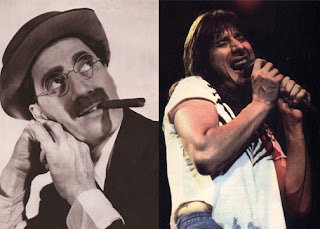
Me, I like to think of my voice as a Groucho Marx sneer belted out by an early-'80s Steve Perry.
* Thank you, Mr. Show "Subway" sketch.
In Chapter 4 of The Weblog Handbook, Rebecca Blood advocates that nascent bloggers will be best off in their ventures by discovering and employing their "authentic voices." In so doing, she is advancing the notion of voice as perspective: "the writer's unique fusion of interests, enthusiasms, and prejudices--her personality" (59). Simultaneously, Blood suggests some support of the notion of "voice" as a mystical expression of the "real writer": a self that will "emerge" as the writer continues to "honestly stretch . . . to meet the world" (72).
I appreciate and endorse the idea that everyone has a perspective, a point of view, that is (at least somewhat) different than everyone else's. I also think that at base writing is an attempt of a person to assert one's self into the world around her. However, I think it is dangerous to assume that this self, this "voice," will magically emerge. I believe the process is one of negotiation and craft; a writer's real mettle, whether in the blogosphere or on essay exams or even e-mails to loved ones, is forged in reaction to and in concert with the outside world. It is a struggle--a larger one for some than for others.
Blood is certainly an advocate of the continual practice and process of writing, but I do fear that her suggestion to write for "an audience of one" is probably dangerous if it is in fact possible. We are social beings, and the way we view the world and then the way we express that view are shaped by the people we interact with, listen to, and read. Our "selves" as audience members are amalgams of the type of audiences of the sorts of things we like to read and hear. So, I suspect that those who claim to write for themselves and end up finding a broader audience for their work are in fact sophisticated readers who have a rich, well-crafted, multi-faceted "audience of one" reviewing their work. But before burgeoning writers can write for their "audience of one," they must themselves become audience members of many, many other writers.
And, I suspect that as if by, ahem, magic, they will find their "voices" strengthen in the process. But it won't be a cakewalk.
Incidentally, if your writing truly had a "voice," would it have the tonal qualities like your actual voice, or do you imagine it as sounding like someone else?
Me, I like to think of my voice as a Groucho Marx sneer belted out by an early-'80s Steve Perry.

Stretching to meet the world, indeed.
* Thank you, Mr. Show "Subway" sketch.
Wednesday, February 6, 2008
All about the Benjamin
In “The Work of Art in the Age of Mechanical Reproduction,” Walter Benjamin wrote about how the technical advancements in the methods to produce and reproduce art changed the very nature in how we view the art. Benjamin argued that the “aura” of a piece of art—its authentic essence connecting it to time, place, and history—is demolished through the ease and acceptance of its reproduction. (While this may be oversimplifying things, let me put forth an example: after seeing countless reproductions of the painting, just what would most of us gain by viewing the Mona Lisa in the Louvre?) Further, Benjamin suggests that as these reproductions meets wider audiences, their “meanings” become more varied and fragmented, very dependent upon the viewers/readers/listeners of the texts:
And while he no doubt foresaw the acceleration of this phenomenon, Benjamin, one can assume, had no way of knowing that access we would have to instantaneous hyper-reproductions of sounds, images, and text—that is to say, the internet (and before it, to a lesser extent, television). The internet takes this reproduction further, as the responder can co-opt, manipulate and repurpose a text in the blink of an eye.
All of which brings me to the next task in crafting blogs in our composition class: the introduction of images to our weekly posts.
I think it’s safe to say that most of the images we view in blogs have been plucked from elsewhere on the internet. While original images would be safest, it is likely that many of the images you put on your blogs will come from elsewhere online. I suggest that you strive for proper attribution of original artwork (in many cases this is handled in the form of a link to the site the picture is from); however, there certainly is a lot of free-form image grabbing out there. Many images are scans from other sources (as I suspect is the case for the picture of the Missing Link I put in my post last week), which probably means that all sorts of copyright infringement is happening, a property endemic to the web. The manipulation of images in photo editing programs like Photoshop, like the image of my friend Tim (where I put his face into an Uncle Sam poster), complicates the issue further, and shows the continual destruction of the “aura” of a work of art that Benjamin wrote about.

By making many reproductions it substitutes a plurality of copies for a unique existence. And in permitting the reproduction to meet the beholder or listener in his own particular situation, it reactivates the object reproduced.
And while he no doubt foresaw the acceleration of this phenomenon, Benjamin, one can assume, had no way of knowing that access we would have to instantaneous hyper-reproductions of sounds, images, and text—that is to say, the internet (and before it, to a lesser extent, television). The internet takes this reproduction further, as the responder can co-opt, manipulate and repurpose a text in the blink of an eye.
All of which brings me to the next task in crafting blogs in our composition class: the introduction of images to our weekly posts.
I think it’s safe to say that most of the images we view in blogs have been plucked from elsewhere on the internet. While original images would be safest, it is likely that many of the images you put on your blogs will come from elsewhere online. I suggest that you strive for proper attribution of original artwork (in many cases this is handled in the form of a link to the site the picture is from); however, there certainly is a lot of free-form image grabbing out there. Many images are scans from other sources (as I suspect is the case for the picture of the Missing Link I put in my post last week), which probably means that all sorts of copyright infringement is happening, a property endemic to the web. The manipulation of images in photo editing programs like Photoshop, like the image of my friend Tim (where I put his face into an Uncle Sam poster), complicates the issue further, and shows the continual destruction of the “aura” of a work of art that Benjamin wrote about.
You'll have to trust me; Tim found it funny.
To be on the safe side, we should add images carefully: we should use free stock image sites or include our own whenever possible and give proper attribution when we use someone else’s image. But for Benjamin’s (or maybe not) sake, include images. In this oftentimes too passive culture, what’s so wrong with a little "object reactivation," after all?
Subscribe to:
Posts (Atom)


